





 For decades, Learning & Development (L&D) occupied a predictable space within organisations—essential, yet often perceived as a support function. Measured in training hours and completion rates, it was frequently categorised as a cost centre rather than a strategic lever.
That narrative is changing—rapidly.
Across industries, corporate learning is evolving into a capability accelerator, directly influencing competitiveness, innovation velocity, and leadership depth. In India, this transformation is unfolding at unprecedented speed. With its demographic dividend, expanding digital infrastructure, and rising appetite for innovation, the country stands at the forefront of a metamorphic shift in how organisations build talent.
The evolution of corporate learning can be traced through distinct phases: from instructor-led classrooms to e-learning platforms; from static digital modules to intelligent, AI-driven learning ecosystems. Today, the next leap is underway—into immersive, experience-driven environments that blur the line between learning and working.
From Delivery Metrics to Capability Outcomes
Historically, corporate training in India relied heavily on Instructor-Led Training (ILT). While limited in scalability and personalisation, it established structured curricula, competency frameworks, and leadership pipelines that powered decades of organisational growth.
The post-pandemic era, however, catalysed a structural reset.
Organisations moved from traditional Learning Management Systems (LMS) to Learning Experience Platforms (LXP) capable of curating and personalising content. India’s smartphone penetration and affordable data access enabled micro-learning in the flow of work. Sales teams began accessing product updates between client visits; plant supervisors revisited SOP simulations on handheld devices; managers consumed targeted content before high-stakes negotiations.
Artificial Intelligence has further transformed the equation. Learning pathways are now recommended based on role, performance indicators, and career aspirations. What was once uniform has become adaptive. Internal knowledge communities and enterprise social platforms amplify peer learning and tacit knowledge sharing—critical in high-context organisational cultures.
Most significantly, learning analytics now connect capability building to business performance. Training is increasingly evaluated not by attendance sheets, but by behavioural shifts, productivity gains, and improved decision quality.
As one industry leader recently observed,
“The real ROI of learning is not completion rates—it is better judgement under pressure.”
This shift from activity metrics to outcome metrics marks the beginning of a more strategic L&D mandate.
The Immersive Inflection Point
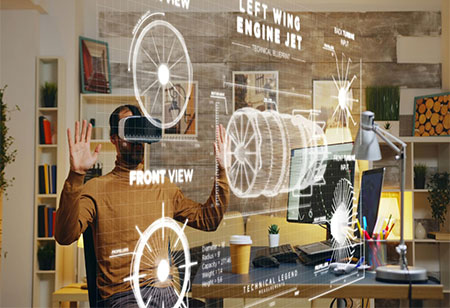
The next frontier lies in immersive technologies—Virtual Reality (VR), Augmented Reality (AR), Mixed Reality (MR), Extended Reality (XR), Digital Twins, and AI-simulated environments. These tools are transforming learning from content consumption into experiential rehearsal.
In sectors such as manufacturing, energy, healthcare, and infrastructure, immersive simulations allow employees to practise high-risk tasks in zero-risk environments. Safety drills, equipment handling, crisis response, and operational troubleshooting can be repeated and refined without real-world consequences.
Leadership development is undergoing a similar reinvention. Immersive labs can simulate boardroom conflicts, M&A negotiations, regulatory crises, and ethical dilemmas. AI-powered avatars can replicate customers, interview panels, or executive coaches—providing immediate behavioural feedback.
Digital twins enable teams to simulate production adjustments, test process innovations, and forecast throughput outcomes before implementation. Combined with AI analytics, these environments generate individual skill heat maps, identify predictive capability gaps, and deliver real-time learning nudges.
Learning, in this context, becomes anticipatory rather than reactive.
The implications extend beyond pedagogy. Immersive technologies are reshaping the L&D operating model itself. The future L&D function will design ecosystems, not courses. Facilitators will guide reflection within simulated environments rather than deliver slide-based instruction. Simulation data will reveal behavioural biases, risk appetite, and leadership maturity with greater precision than traditional assessments.
The Power of Convergence
The real transformation, however, lies in technological convergence:
- AI + VR enabling adaptive simulations that evolve with learner behaviour
- IoT + Digital Twins powering real-time operational training
- 5G + XR facilitating high-fidelity remote collaboration
- Blockchain-based learning records creating verifiable skill credentials
India’s expanding 5G infrastructure and cost-efficient device ecosystem position it to accelerate this convergence rapidly. For organisations operating in dynamic markets, learning is increasingly becoming the engine of transformation—not merely a supporting function.
Beyond Technology: The Design Imperative
Yet technology alone does not guarantee impact.
Many organisations invest heavily in platforms and hardware but struggle to translate them into meaningful capability gains. The differentiator lies in experience design. Effective immersive learning demands the integration of instructional design, behavioural science, animation engineering, data analytics, and deep contextual understanding of business realities.
Generic content frameworks rarely deliver transformative outcomes. Customised digital learning ecosystems—aligned with organisational strategy, industry dynamics, and cultural context—are essential.
For CEOs and boards, the strategic question is no longer whether to invest in learning, but how ambitiously to reimagine it.
Keeping Learning Human
Amid rapid digitisation, one principle must remain central: learning is fundamentally human.
Immersive technologies should amplify empathy, ethical judgement, collaboration, and purpose—not merely operational efficiency. The objective is not to create technologically proficient employees alone, but adaptive and responsible leaders capable of navigating uncertainty.
As organisations confront accelerating disruption—from AI integration to geopolitical volatility—their ability to learn faster than the market may become their most enduring competitive advantage.
The enterprises that will define the next decade will not be those that deliver the most training hours, but those that architect the most resilient capabilities.
In that sense, corporate learning is no longer a peripheral function. It is becoming the operating system of the future enterprise.