



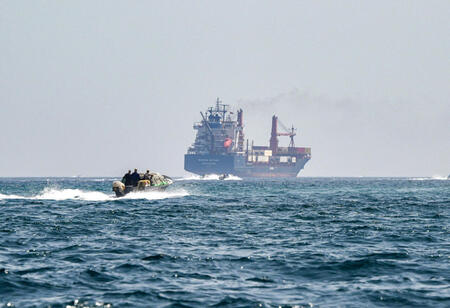
The European Commission has strongly dismissed any efforts by Iran or the United States to impose fees on ships passing through the Strait of Hormuz, although it acknowledged that the ultimate choice to pay a fee rests solely with the companies involved.
"International law guarantees the freedom of navigation; what does this imply?" "It signifies no fees or charges of any kind," a spokesperson for the Commission stated on Thursday afternoon in reply to a question from Euronews.
"The Strait of Hormuz, similar to other sea routes, serves as a public asset for all people, indicating that navigation should remain unrestricted." Restoration of navigation freedom is essential.
The backlash follows a day after US President Donald Trump raised alarms in Europe by proposing a "joint venture" with Tehran to implement a pay-to-pass system on the crucial waterway, essential for the transport of oil, gas, and fertilizer supplies.
Karoline Leavitt, the press secretary for the White House, later mentioned that the proposal would "remain under discussion" but emphasized that the "urgent focus" was to reopen the shipping lane "without any restrictions, either in the form of tolls or other means".
Since the onset of US-Israeli strikes on 28 February, Iran has maintained strict control over Hormuz, disrupting supply chains and causing global energy prices to surge.
Also Read: Greece to Ban Social Media for Under-15s from 2027, Says PM
Trump stated that the ceasefire agreement revealed earlier this week would result in the "safe" reopening of Hormuz. However, the narrow route was once more shut on Wednesday following Israel's extensive attacks on Lebanon, an action that Iran deemed a breach of its interpretation of the 10-point plan.
On Thursday, uncertainty persisted in Hormuz, as traffic information indicated that merely a few vessels had succeeded in passing through.
Also Read: Idorsia Appoints of Dr. Amer Joseph as Chief Medical Officer
Approximately 2,000 vessels and 20,000 sailors are still stranded in the Persian Gulf.
Iran is said to be utilizing a new system that imposes a fee of $1 for every oil barrel held on each vessel. Payment can be conducted using either Chinese yuan or cryptocurrency, which are two alternatives that evade Western financial regulation.
Also Read: EU Lawmakers Want to Tax Big Tech to Fund Budget
For Brussels, both Trump's "joint venture" and Iran's $1-per-barrel approach are unacceptable as they violate the United Nations Convention on the Law of the Sea (UNCLOS), which explicitly bars charging for mere transit. Charges are permitted only when a particular service, like port access or maintenance, is rendered.