





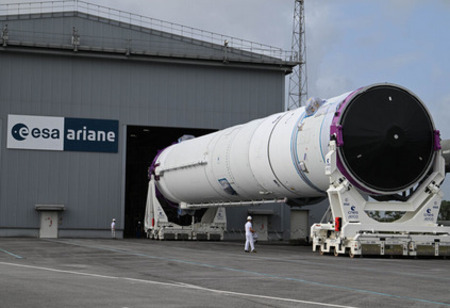
Arianespace has confirmed that the inaugural launch of their enhanced Ariane 6 rocket, equipped with four boosters, is scheduled for 12 February at the Guiana Space Centre in French Guiana. Europe's premier rocket industry leader is engaged in fierce competition with major players worldwide, including the dominant company in the global market, SpaceX, founded by Elon Musk.
Engineers at the Vernon plant of ArianeGroup are responsible for the design, integration, and testing of engines for the European heavy-lift launcher.
In Les Mureaux, located west of Paris, meticulous construction and assembly of the rocket's main stage components are taking place. Within these facilities, a dedicated team of specialized professionals work tirelessly to transform the concept of space exploration into a routine occurrence.
"It's a special launch - something new for us on Ariane 6," ArianeGroup Chief Technical Officer Herve Gilibert said. This flight marks the debut of the four-booster configuration, making the rocket roughly twice as powerful as the version flown since 2024, he says.
“Don't be surprised if you see it accelerate much more than Ariane 62, the version we have already launched five times”, Gilibert says. “It delivers significantly more power, allowing much heavier payloads to be sent into space”.
The Ariane 6 program involves collaboration and financial support from 13 European nations that are members of the European Space Agency, with components such as the launcher, engines, and avionics manufactured in various countries across Europe.
Before the launch, all parts have been transported across the Atlantic to French Guiana for the final construction process. The rocket measures approximately 62 meters (203 feet) in height, which is comparable to that of a 20-story building. After taking off, the operation is expected to continue for approximately one hour and 50 minutes, which is almost equivalent to completing a full orbit around the Earth.
The satellites will then be released in pairs from the upper section of the rocket. The aim of Amazon Leo's constellation is to rival SpaceX's extensive network of Starlink satellites. The rocket is propelled at launch by the assistance of four boosters, which work together to consume 142,000 kilograms (313,056 pounds) of solid propellant in a span of slightly over two minutes until their combustion is completed.
According to Viallon, Ariane 6 was meticulously developed to decrease operational expenses by fifty percent in comparison to its forerunner, Ariane 5. The Ariane 5 program, which commenced in the late 1970s with the aim of providing Europe with autonomous space access, concluded in 2023 with its final launch.