



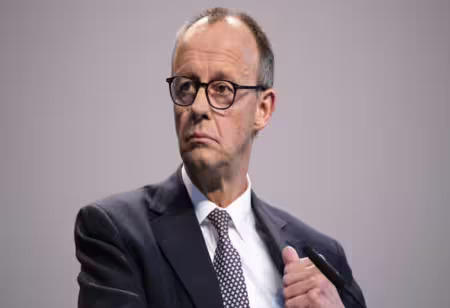
German Chancellor Friedrich Merz and Brazilian President Luiz Inacio Lula da Silva urged for strengthened relationships between South America's largest economy and the European Union during the inauguration of the Hanover industrial fair on Sunday.
Both expressed approval for the implementation of the EU-Mercosur free trade agreement starting May 1.
"This indicates our commitment to the multilateral framework, our preference for a rules-based economic system, and our desire for cooperation with minimal tariffs – ideally, none," Merz stated.
Lula characterized Brazil, this year's partner nation at the largest industrial trade fair in Hanover, as a dependable and significant collaborator, particularly in the provision of raw materials.
Despite having mapped only around 30percent of its mineral potential, Brazil possesses the largest niobium reserves globally, the second-largest graphite and rare earths reserves, and the third-largest nickel reserves, according to Lula.
Also Read: Hormuz must Open; G7 to Mitigate Fallout: French Minister
"These raw materials should act as a catalyst for economic and social advancement," he stated, urging for increased technology transfer and enhanced processing capacity to be developed in Brazil.
Lula expressed his desire to explore the complete scope of economic collaboration with Merz, covering areas like artificial intelligence, essential minerals, and data centers.
Also Read: Macron, Starmer Hold International Summit on Strait of Hormuz
German-Brazilian government discussions are scheduled for Monday.
"AI will enhance efficiency and productivity, improve resource utilization, and ultimately, lower costs," he mentioned.
Germany has been keen to keep pace with leading AI nations the United States and China in a worldwide competition to excel in a groundbreaking technology and draw high-paying jobs.
Also Read: European Leaders Push ‘Defensive’ Hormuz Mission After Reopening
Last month, Berlin aimed to stimulate investments to enhance AI data processing capacity by a minimum of four times by 2030.