



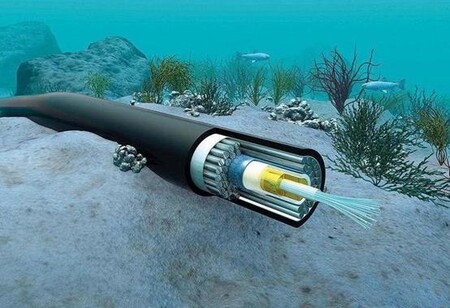
The Strait of Hormuz has emerged as one of the world’s most critical digital and economic chokepoints, serving not only as a key maritime trade corridor but also as a vital artery for global internet connectivity. According to Turkey’s state-run news agency, Anadolu Agency, the region houses nearly 17 major submarine cable systems that carry around 30 percent of global internet traffic and approximately 90 percent of data transfers between Asia and Europe.
These undersea cables support more than $10 trillion in financial transactions every day, enabling communication networks, cloud services, and financial operations across the Gulf and beyond.
At the same time, the Strait remains indispensable to global energy trade, handling over 25 percent of the world’s seaborne oil shipments along with significant volumes of LNG and fertilizer exports. However, escalating disruptions in the region have triggered a dramatic collapse in shipping activity, with traffic declining by more than 95 percent. The impact has quickly spread across global markets, pushing Brent crude prices above $90 per barrel and placing severe pressure on already strained supply chains.
The consequences extend far beyond the Gulf. Rising energy, freight, and food costs are expected to weigh heavily on economies worldwide, particularly developing nations that remain vulnerable to inflation and supply disruptions.
Analysts warn that the ongoing crisis could significantly slow global trade growth in 2026, reducing expansion to between 1.5 and 2.5 percent. As geopolitical tensions intensify, the Strait of Hormuz is increasingly being viewed not just as an energy chokepoint, but as a strategic hub whose stability is essential to both the physical and digital foundations of the global economy.
The Iran Flashpoint
The conflict with Iran, which commenced on February 28, 2026, has forced an engagement with this pressing issue. Beyond the visible layers of military activity and geopolitical strategies, there lies a quieter yet significantly more impactful crisis. The physical infrastructure essential to powering the global internet now faces potential threats in ways that few policymakers, businesses, or even technology leaders had fully anticipated. For the first time, the ocean floor itself has emerged as a strategic frontline.
The popular imagination treats the internet as something abstracts a virtual space that exists independently of geography. At the core of this infrastructure are submarine fibre-optic cables. These cables, often no thicker than a garden hose, carry pulses of light that transmit data across continents. Approximately 97 percent of global intercontinental internet traffic flows through these cables. Even military communications, often assumed to rely primarily on satellites, depend heavily on them.
Despite their importance, submarine cables remain largely invisible in public discourse. They lie on the ocean floor, out of sight and out of mind. Yet they are among the most critical components of modern infrastructure. Without them, global connectivity would collapse.
The idea that the internet is infinitely resilient stems from its origins in Cold War research. Early network designs emphasized decentralization, allowing data to be rerouted around damaged nodes. While this principle still holds, it is often misunderstood. Redundancy exists, but it is not unlimited. More importantly, it is not evenly distributed across the globe.
Chokepoints: Where Geography Still Matters
The global network of submarine cables is shaped by geography. Certain narrow waterways known as chokepoints serve as critical junctions where multiple cables converge. These chokepoints are essential for connecting different regions of the world, but they also represent points of vulnerability.
Two such chokepoints have come into focus during the Iran conflict: the Red Sea and the Strait of Hormuz. Both are vital not only for energy transportation but also for data transmission. Submarine cables linking the Gulf region to Europe, Africa, and Asia pass through these corridors.
Historically, disruptions in one corridor could be mitigated by rerouting traffic through another. This redundancy provided a measure of resilience. However, the current conflict has simultaneously affected both routes, creating an unprecedented situation.
The closure or effective restriction of these chokepoints has turned them into bottlenecks for global data flows. This is not merely a regional issue. It has implications for connectivity across continents, affecting everything from financial systems to cloud computing.
Challenging Aspect of Undersea Cable
One of the most challenging aspects of undersea cable disruption is that its effects are often gradual rather than immediate. Unlike a power outage, which produces an instant and visible impact, cable disruptions typically result in degraded performance.
Data can be rerouted through alternative paths, but these paths are longer and have limited capacity. As more traffic is diverted, congestion increases. The result is slower speeds, higher latency, and reduced reliability.
This form of degradation can persist for extended periods. It affects a wide range of services, including video conferencing, financial transactions, and cloud-based applications. While the impact may not be dramatic, it is cumulative. Over time, it can significantly disrupt economic activity and digital operations.
The Repair Problem: A Critical Constraint
Perhaps the most significant factor in the current crisis is not the damage itself but the difficulty of repairing it. Submarine cables are designed to be repairable. Under normal conditions, faults caused by anchors, fishing activity, or natural events can be fixed within weeks.
The repair process is highly specialised. Cable ships must locate the break, retrieve the damaged section from the seabed, and splice in a replacement. This requires stable conditions and safe access to the affected area.
In conflict zones, these conditions do not exist. The Red Sea and the Strait of Hormuz have become high-risk environments, making it unsafe for repair vessels to operate. As a result, even minor faults can remain unresolved for months.
This creates a compounding problem. Each additional fault reduces network capacity further, increasing pressure on remaining routes. Over time, the system becomes increasingly fragile.
The Limits of Redundancy
The belief that the internet can always “route around damage” is rooted in truth but often overstated. Rerouting is possible, but it has limits.
Alternative routes may involve significantly longer distances. For example, traffic may need to be rerouted around Africa’s Cape of Good Hope, adding thousands of kilometres to data journeys. This increases latency, affecting time-sensitive applications.
Moreover, alternative routes have finite capacity. As more traffic is diverted, these routes can become congested. Rerouting does not restore lost capacity; it merely redistributes the load.
In extreme cases, the system may reach a point where further rerouting is not possible without severe degradation of service.
The Timing: A Collision with the AI Boom
The current crisis has emerged at a time of rapid expansion in digital infrastructure. Over the past decade, there has been a surge in investment in data centres, cloud computing, and artificial intelligence.
The Gulf region has been a focal point of this investment. Its geographic position makes it an ideal hub for connecting Europe, Asia, and Africa. Companies have invested billions in building infrastructure designed to support the next generation of digital services.
These investments were based on the assumption of stable and reliable connectivity. The Iran conflict has challenged this assumption. It has exposed the extent to which digital infrastructure depends on physical systems that are vulnerable to geopolitical risk.
Also Read: The Best Way to Recover from Ransomware Attacks
The Convergence of Physical and Cyber Threats
One of the most important developments in the current conflict is the convergence of physical and cyber risks. Traditionally, these risks have been treated as separate domains. Physical infrastructure was the concern of engineers and policymakers, while cybersecurity was the domain of IT professionals.
This separation is increasingly untenable. Damage to physical infrastructure affects the ability to respond to cyber incidents. Reduced connectivity can hinder communication, delay data transfers, and complicate recovery efforts.
At the same time, cyberattacks can exploit weakened networks, amplifying the impact of physical disruptions. The combination of these factors creates a more complex and challenging threat environment.
Previous incidents involving submarine cables have provided warnings about these vulnerabilities. Damage in regions such as the Baltic Sea highlighted the potential for disruption, whether accidental or deliberate.
However, these incidents were often treated as isolated events. Their impact was largely regional, and global connectivity remained intact. The current crisis is different. It affects critical intercontinental routes and involves multiple overlapping risks.
This shift underscores the need to rethink how undersea cable vulnerabilities are understood and managed.
Implications for Global Connectivity
For countries with ambitious digital growth strategies, the implications are significant. India, for example, is rapidly expanding its data centre capacity and positioning itself as a major player in the global digital economy.
This growth depends on reliable international connectivity. Submarine cables are the backbone of this connectivity. Disruptions can affect everything from cloud services to cross-border data flows.
Also Read: The Future of Sustainable Maritime Operations & Biofouling Regulation
The current crisis highlights the importance of incorporating geopolitical risk into infrastructure planning. Technical resilience alone is not sufficient.
Rethinking Resilience
The Iran conflict has revealed gaps in how resilience is defined and implemented. Traditional approaches focus on redundancy and failover systems, assuming that disruptions will be temporary.
The current situation suggests that this assumption may no longer hold. Infrastructure disruptions in conflict zones may persist for extended periods, requiring new strategies for maintaining operations.
These strategies may include greater geographic diversification, improved monitoring of cable routes, and closer coordination between governments and industry.
Also Read: Preparing for the Next Phase of Cyber Risk
Toward a Fragmented Internet
One of the most significant long-term risks is the potential fragmentation of the global internet. Instead of a seamless network, the world could see the emergence of regional clusters with limited interconnection.
This would have profound implications for trade, communication, and innovation. The free flow of data, which underpins the modern economy, could be constrained by geopolitical boundaries.
While this outcome is not inevitable, the current crisis suggests that it is a possibility that must be taken seriously.
The Iran war has expanded the boundaries of conflict into a domain that has long been overlooked. The ocean floor, home to the cables that power the global internet, is now a strategic space.
This development challenges long-held assumptions about the resilience of digital infrastructure. It highlights the interconnected nature of physical and digital systems and underscores the importance of protecting both.
The internet is no longer just a virtual network. It has a physical presence, and that presence is vulnerable. As the world grapples with this reality, the need for a more resilient and secure infrastructure has become clear.
The cables beneath the ocean may be out of sight, but they are no longer out of mind.