



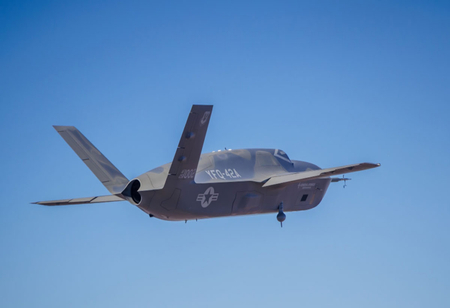
The future fighter jets of Europe might not engage in battle solo. Military strategists are progressively anticipating their collaboration with autonomous planes that can transport munitions, collect intelligence, perform electronic warfare, and bear risks in disputed airspace.
Airbus' latest U760 Ravenstorm provides one of the most distinct glimpses of how that future may appear.
The airplane, showcased as a life-size model at ILA Berlin earlier this month, represents Airbus Defence and Space's newest effort to create a European footprint in the fast-growing market for collaborative combat aircraft (CCA), often referred to as loyal wingman systems.
Created to work in conjunction with manned fighters, Ravenstorm embodies an increasing conviction among military strategists that future aerial dominance will rely equally on autonomous systems as on piloted aircraft.
Its arrival coincides with European countries increasing defense budgets, reevaluating the insights gained from the conflict in Ukraine, and pursuing enhanced control over essential defense technologies, including artificial intelligence, mission systems, and communications networks.
Also Read: The Protein Brewery Secures EU Green Light for Fermotein Mycoprotein
Airbus states it has been enhanced for multi-domain operations, such as air-to-ground attacks using precision-guided munitions, air-to-air defense missions with medium- and long-range missiles, and electronic warfare efforts aimed at neutralizing enemy air defenses and aiding offensive counter-air operations.
Airbus states that Ravenstorm signifies the next phase in its plan for a scalable range of cooperative combat aircraft. The firm aims for availability by the early 2030s.
In contrast to traditional drones which typically have a singular purpose, collaborative combat aircraft are designed to act as force amplifiers.
They can transport extra weapons, increase sensor range, conduct electronic warfare operations, and function in more perilous settings without risking pilot safety.
For air forces encountering more advanced air-defense systems, that adaptability is growing more appealing.
Airbus considers Ravenstorm to be an element of a wider change in military aviation.
“Whatever uncrewed or ‘drone’ capability our clients require to enhance sovereign air power, we provide,” stated Mike Schoellhorn, CEO of Airbus Defence and Space.
“Our collection includes swift-response drone interceptors and multiple tactical drones, autonomous cargo helicopters, as well as uncrewed fighter aircraft UCCAs collaborating with crewed fighter jets. At the opposite end of the spectrum, we find the Eurodrone, our extremely high payload and exceptionally long endurance ISTAR system. Airbus offers the complete range of uncrewed capabilities needed for contemporary multi-domain combat," adds Mike.
Also Read: Albania’s Edi Rama Calls for Bold European Expansion
The arrival of aircraft like Ravenstorm signifies wider shifts in the nature of aerial combat.
The situation in Ukraine has highlighted a lesson that defence planners had already started to recognize: upcoming air operations will rely not just on sophisticated fighters but also on numerous interconnected, progressively autonomous systems that can enhance combat strength and mitigate operational risk.
Also Read: Péter Magyar’s EU Summit Debut Marks New Chapter for Hungary
Electronic warfare, decentralized operations, and swift information dissemination have gained equal significance to traditional kinetic impacts.