



European leaders have announced that they were speeding up arrangements for a neutral, defensive multinational operation to ensure shipping safety in the Strait of Hormuz, despite Iran's earlier statement claiming that the water route had been completely reopened to maritime navigation for the duration of the ceasefire, which is set to end on 22 April.
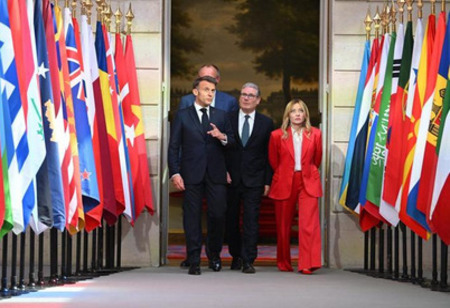
Co-chaired by French President Emmanuel Macron and British Prime Minister Keir Starmer, the Paris meeting convened 49 nations, primarily through video conference, to deliberate on a future defensive initiative focused on ensuring freedom of navigation when circumstances permit.
Also Read: Macron, Starmer Hold International Summit on Strait of Hormuz
According to Donald Trump, the US was excluded from the initiative, which France and Britain have characterized as different from the warring parties and apart from Washington's ongoing blockade strategy.
The US President declared in an all-caps social media message that the US Navy's blockade of Iranian ports would continue "UNTIL SUCH TIME AS OUR TRANSACTION WITH IRAN IS 100% COMPLETE."
Macron endorsed the ceasefire between the United States and Iran as well as the truce regarding Lebanon, stating that these recent events were progressing "in the right direction."
He stressed that all parties must now guarantee the strait's complete, prompt, and unconditional reopening.
He also resisted any efforts to convert transit through Hormuz into a toll-based or restricted system, asserting that the waterway should not be subject to privatization.
Starmer echoed this sentiment, stating that Iran's declaration was positive, but emphasized that "we must ensure it is a sustainable and practical plan."
He mentioned that leaders had decided to accelerate military planning for a multinational mission "as soon as conditions permit," and revealed a subsequent military conference in London next week following offers of asset contributions from over a dozen countries.
Also Read: Hormuz must Open; G7 to Mitigate Fallout: French Minister
Approximately 20 percent of the global oil and liquefied natural gas typically transits through the Strait of Hormuz, and weeks of interruptions have unsettled energy markets, left ships stranded, and caused over 20,000 sailors to be trapped in the area.
European governments have declined to participate in the US blockade of Iranian ports, stating that it would be equivalent to engaging in the war.
Italian Prime Minister Giorgia Meloni, attending an event in Paris, claimed that the issues extend beyond energy, stating that fertilizers are essential for global food security as well.
She stated that it was essential for Iran to give up any ambitions for nuclear weapons and emphasized that Italy was prepared to contribute to a future initiative.
In her perspective, that position would center on comforting commercial ships in the strait, particularly by assisting in confirming the absence of mines, within what she emphasized would be an exclusively defensive undertaking.
Also Read: EU Heads to Budapest for Talks with Magyar on Frozen Funds
German Chancellor Friedrich Merz cautioned about the possibility of a wider and "multifaceted global conflict" if the crisis is not controlled.
He suggested that Germany could play a role in a future initiative, possibly involving mine clearance.
He stated that Germany, "if feasible, would additionally prefer the United States of America to join; we think this would be beneficial," contradicting the earlier remark by the French president about excluding all combatants from the mission.