



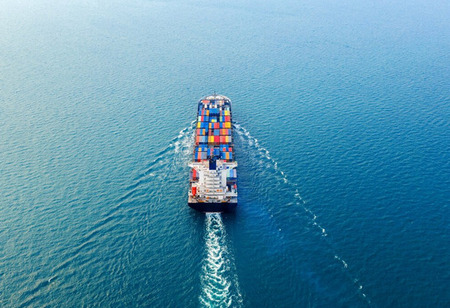
A vessel displaying French ownership indicators has departed the Strait of Hormuz, marking the presumed initial passage of a ship associated with Western Europe since the disruption of the critical waterway due to the Iran conflict.
The vessel known as CMA CGM Kribi departed from the vicinity of Dubai and began its journey towards Iran on Thursday afternoon, as indicated by data from ship-tracking systems. Owned by a French entity, the ship maintained proximity to the Iranian coastline, navigating through a passageway between the islands of Qeshm and Larak while openly transmitting its location.
Also Read: Macron Praises Europe’s Predictability in Japan Visit
By morning, it was reported to be positioned off the coast of Muscat. Traffic flow in the Strait of Hormuz has come to a virtual standstill following the recent military actions carried out by the United States and Israel against Iran. Only a minimal number of ships are currently making the voyage through the area.
These vessels are primarily from countries considered to be allies, and a new procedure is beginning to take shape whereby Iran grants permission in advance for passage along a designated route that runs near its coastline. For instance, Pakistan has negotiated an agreement for 20 ships to pass under its flag, and various Asian nations have likewise arranged for safe transport through the region.
European countries, such as France, are taking preliminary diplomatic actions to alleviate the crisis; however, there has been no reported advancement thus far. President Emmanuel Macron, during a visit to South Korea, stated on Friday that France will strive to stabilize the situation in Hormuz, "following the termination of the bombardments.
The ship under the Maltese flag is owned by a French company, CMA CGM SA, one of the world's top container shipping companies, primarily controlled by the wealthy Saadé family.
The company was established in Marseille in 1978 by the founder, who moved to France from conflict-ridden Lebanon and began operations with a single rented vessel.
Also Read: Europe to Negotiate With NASA on Lunar Missions
The company and the French Ministry of Foreign Affairs both refrained from providing any comments. There was no response from the Ministry of Finance of France following a request for comment. Monitoring ships as they enter and leave the Hormuz region is a complex task that is hindered by the deliberate interference of signals and the deceptive manipulation of signals.
Three additional vessels were observed departing the Gulf via the strait on Thursday, albeit further south along Oman's coast. Although traffic remains below pre-war levels, there has been a slight increase in activity. In the meantime, Iran is implementing measures to solidify its control over the strait for an extended period, seeking to implement a toll system for a vital waterway that is essential for global oil and gas supply.
Also Read: Spain Weighs Tourism Boost against Middle East War Risks
This development is causing concern among Gulf Arab nations, as they heavily depend on the strait for their exports, and it also presents obstacles for consumers worldwide. The CMA CGM Kribi has a capacity of approximately 5,000 twenty-foot equivalent units (TEUs) and is currently displaying low draft readings, suggesting that it is carrying a full load of cargo. According to company reports, 14 of its vessels are currently stranded in the Persian Gulf, unable to navigate through the strait.