



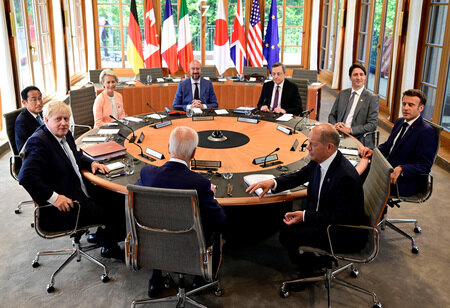
European leaders are leveraging the G7 summit in the French lakeside town of Evian-les-Bains to confront U.S. President Donald Trump regarding the dangers of a rushed interim Iran agreement while advocating for a reassessment of Washington’s strategy in the Ukraine conflict.
The gathering spanning three days (15-17 June) unites the leaders from the United States, France, Britain, Germany, Italy, Canada, Japan, and the European Union.
This follows shortly after Washington and Tehran revealed a preliminary ceasefire deal to stop their direct confrontation and reopen the Strait of Hormuz.
Trump, who reached Evian on Monday encouraged by the progress, announced that the deal was “all signed” and mentioned that its complete text would be made public following a formal signing ceremony planned for Friday in Geneva.
He mentioned that the strategically important waterway would be “fully open” by that time. Vice President JD Vance is anticipated to attend the ceremony on behalf of the U.S.
Also Read: US Limits on Frontier AI Access Send Warning Signal to Europe
Nonetheless, specifics of the memorandum are still scarce and unclear. The accord prolongs a tenuous April truce by 60 days, during which discussions are anticipated to address Iran’s nuclear program, ballistic missile abilities, easing of sanctions, and regional proxy operations.
Iranian officials have referred to it as a “significant advancement” but emphasized that a permanent ceasefire has not yet occurred.
Also Read: ACI Worldwide, EPI Boost Instant Payments in Europe
French President Emmanuel Macron stressed the importance of a “concrete, serious agreement that is completed,” as European diplomats express concern that the existing draft may reinforce Tehran’s nuclear and missile activities without adequate protections.
France, Britain, and Germany are advocating for an expanded role in the upcoming phase of negotiations, leveraging their extensive experience with the 2015 nuclear agreement that Trump discarded during his initial term.
Also Read: Oriva Therapeutics appoints Dr Agnès Arbat as CEO
A lunch session on Tuesday at the summit is anticipated to concentrate on the secure reopening of the Strait of Hormuz, possibly featuring a maritime mission led by France and the UK, along with alternative energy pathways. Leaders from Egypt, Qatar, and the UAE are present to clarify regional expectations.
Regarding Ukraine, European leaders view the G7 as a chance to persuade Trump that earlier U.S. suggestions have been too accommodating to Moscow.
Ukrainian President Volodymyr Zelenskyy is attending sessions focused on “establishing peace in Ukraine” and might engage in one-on-one discussions with Trump. Zelenskyy proposed a meeting with Russian President Vladimir Putin at the summit, but Moscow has displayed minimal interest.
European Commission President Ursula von der Leyen emphasized Ukraine's strength in combat and the economic difficulties faced by Russia due to sanctions, indicating ongoing European dedication to aiding Kyiv while maintaining pressure on Moscow.