



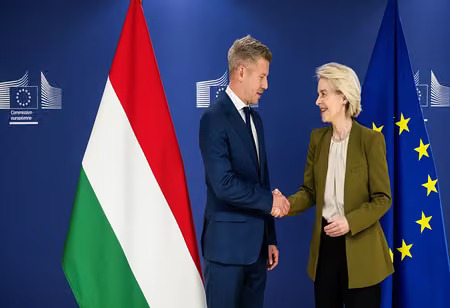
 The European Commission has authorized Hungary’s €5.4 billion defense loan request, finalizing the initial phase of SAFE allocations and maintaining slightly more than €21 billion for a subsequent funding round.
Hungarian Prime Minister Péter Magyar reduced the application sum from €16.4 billion to €5.4 billion following his April inauguration, with the official application updated and submitted at the end of September.
Magyar reportedly aimed to re-evaluate the initial proposal due to supposed corruption risks associated with the prior administration.
Prior to the distribution of funds, they need to receive approval from EU governments, followed by the signing of a loan agreement by delegates from Brussels and Budapest.
European Commission spokesman Thomas Reginer affirmed that over €21 billion is still available in the €150 billion funding package.
Member states will be encouraged to show their interest in acquiring extra loans or entirely new loans by December, after which the Commission will evaluate possible new proposals.
Countries such as Ireland, which did not secure a primary SAFE loan, have shown interest in possibly participating in the upcoming round.
In October, Ireland's Defence Minister Helen McEntee expressed her wish for Dublin to participate. “I’ve expressed that aspiration quite clearly,” she stated.
Also Read: LG Energy Solution, Energix Explore 2 GWh Battery Storage Supply Deal
A total of 19 member states applied for SAFE loans aimed at strategic defence investments, amounting to €129 billion. The pool of funding had €150 billion accessible.
SAFE serves as a crucial element of the European Commission’s ReArm Europe 2030 initiative, designed to expedite orders, ensure supply chains, and enhance manufacturing by assisting nations in joint procurement for specific prioritized capabilities.
Also Read: EU and Canada Strengthen Cooperation on Health Emergency Preparedness
This encompasses munitions, drone and anti-drone technologies, air defense, military maneuverability, and electronic combat capabilities, among other aspects.
Multiple intelligence agencies have pinpointed the year 2030 as the potential time when Russia might initiate military aggression against NATO.
The initiative promotes collaborative purchasing, enhanced industrial collaboration, and improved interoperability throughout Europe.
Also Read: Norway and Finland Leaders Hold Rare Talks with Putin
A minimum of 65% of the component expenses must come from the EU, Ukraine, and specific nations within the European Economic Area and European Free Trade Association.