



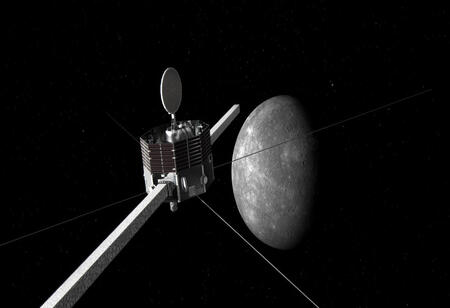
Japan and Europe have successfully placed two spacecraft into orbit around Mercury as part of the BepiColombo mission, marking a major milestone in efforts to explore the solar system’s innermost planet.
According to the European Space Agency (ESA), the Japan Aerospace Exploration Agency’s (JAXA) Mio probe and the ESA’s Mercury Planetary Orbiter (MPO) entered Mercury’s orbit on Sunday, Japan time, following an eight-year journey through space.
The two spacecraft will conduct separate investigations to provide scientists with a better understanding of Mercury’s environment. The Mio probe will study the planet’s magnetic field, while the MPO will examine its surface conditions and other characteristics.
The spacecraft were launched together in October 2018 and have travelled as a combined unit throughout most of their journey. The mission aims to collect important scientific data about Mercury, including information about its magnetic environment and atmosphere.
BepiColombo was initially scheduled to reach Mercury in December 2025. However, the arrival was delayed by approximately one year because of technical problems involving the spacecraft’s propulsion system.
Also Read: Greaves Cotton Expands Multiflex Marine Business, Eyes Europe
The successful arrival represents only the second time in history that a spacecraft has entered orbit around Mercury. The United States’ Messenger spacecraft achieved the same milestone in March 2011, becoming the first probe to orbit the planet.
Also Read: France's OVHcloud Launches AI Cloud Products Hosted in Europe
Scientists hope the latest mission will provide valuable insights into Mercury’s formation, structure and evolution. Despite being the closest planet to the Sun, Mercury remains one of the least explored planets in the solar system.
Also Read: EU and Britain Set to Reset Ties with New Deals After Brexit
The BepiColombo mission is a joint project between Japan and Europe and is expected to contribute significantly to scientific understanding of the planet through observations made by its two specialised spacecraft.