



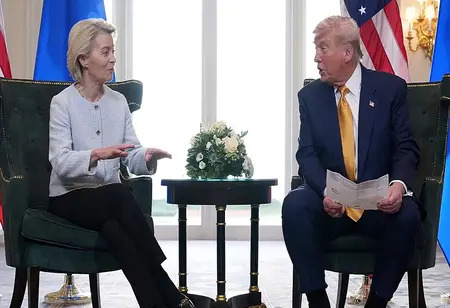
The European Parliament and the Cypriot presidency, representing EU member states, were unable to finalize an agreement last night regarding the removal of EU tariffs on US industrial products as per the Turnberry agreement made last summer.
The obstacle arises merely days after the US increased pressure on European negotiators by threatening to implement 25percent tariffs on EU vehicles — surpassing the 15percent limit on US tariffs for EU products established last summer by US President Donald Trump and European Commission President Ursula von der Leyen in Turnberry.
Although the round of talks ended unsuccessfully and continued into the night, the Cypriot presidency stated that the discussions created “positive momentum” between both parties and that negotiators achieved “progress.”
Time is running out, and the pressure has escalated in recent days from the European Commission, which is urging prompt execution of the EU-US agreement, and from leaders of the conservative European People’s Party, the largest political group in Parliament, who claim businesses require certainty.
Also Read: Nine New Restaurants in Belgium Awarded Michelin Stars
Cypriot Trade Minister Michael Damianos aimed to calm them, stating that “the Council is dedicated to promptly progressing with the implementation” of the agreement, and adding: “We are entirely devoted to maintaining our cooperative dialogue with the European Parliament.”
Also Read: G7 Trade Ministers Meet in Paris Amid Rising Tariff Tensions
An EU diplomat informed Euronews that the aim of yesterday’s discussions was primarily for both parties to present their political stances, with technical negotiations anticipated at a subsequent phase. Negotiators are currently aiming for a fresh set of talks on 19 May.
Parliament has included robust safeguards in the EU–US deal, although member states do not back all of them, despite broadly agreeing on the need to protect the agreement from future threats by Trump, such as those concerning EU cars or Greenland earlier this year.
Also Read: Google Proposes Spam Policy Changes to Avoid EU Fine
Bernd Lange, a German socialist MEP said that “there is still some way to go,” but added that negotiators “made good progress on the issue of the safeguard mechanism and the review and evaluation of the main regulation.”
Parliament’s demands include making the deal temporary, with an expiry date in March 2028, just months before the end of Trump’s second term.