



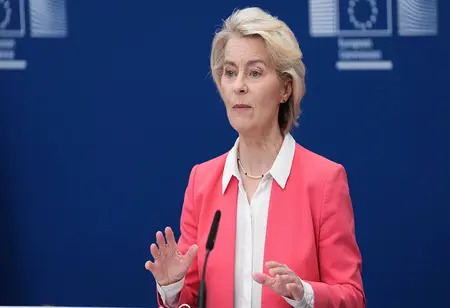
European Commission President Ursula von der Leyen has strongly condemned Russia’s latest wave of attacks on Ukraine, describing them as “horrible atrocities,” and announced a fresh €1.4 billion support package funded through proceeds from immobilised Russian assets.
The announcement came a day after Russia launched overnight ballistic missile and drone strikes on Kyiv, which killed at least 17 people and targeted civilian areas. The attacks are part of a broader escalation in recent weeks, as Russia continues to intensify its offensive against Ukraine.
“Once again we wake up to the news of horrible atrocities by Russia through its aerial attacks on Ukraine. Russia must pay for the destruction it has caused,” von der Leyen stated.
She emphasized that the newly allocated €1.4 billion would help sustain Ukraine’s resistance against what she termed Russia’s “illegal war.”
Following Russia’s full-scale invasion in 2022, the European Union froze Russian Central Bank assets held within its jurisdiction. While the assets themselves remain untouched, the profits generated from them—amounting to approximately €8 billion—have been redirected to support Ukraine.
Also Read: Suzuki Targets Europe with Electric Kei Car by 2027
Of the latest €1.4 billion tranche, around 95% (approximately €1.33 billion) will not be used for direct military aid. Instead, the funds will be channelled through the Ukraine Loan Cooperation Mechanism to assist in servicing loans provided under joint G7 and EU financial initiatives.
Also Read: EU Launches €5B Scaleup Europe Fund to Boost Global Tech Growth Plans
The remaining €70 million will be allocated via the European Peace Facility, which is designed to finance military assistance to Ukraine.
Also Read: Qualcomm Nmaes Wassim Chourbaji as SVP and President
The move underscores the EU’s continued commitment to backing Ukraine financially and politically, even as debates persist over the long-term use of frozen Russian assets and the broader implications for international financial systems.