



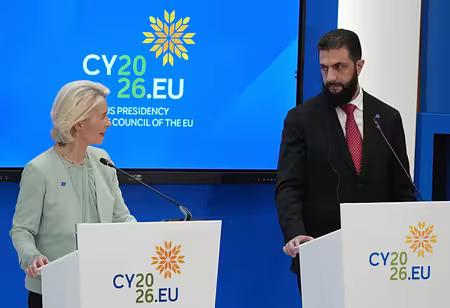
EU leaders pledged to enhance security and economic relationships with Middle Eastern allies and advocate for a diplomatic resolution to the Iran conflict, following discussions in Cyprus centered on the consequences of the war.
Leaders from Lebanon, Egypt, Syria, and Jordan, along with the Gulf Cooperation Council's secretary general, gathered in Nicosia to engage with their European Union counterparts during an EU summit.
"The present circumstances clearly highlight the close connection between Europe's security and that of the Middle East, demonstrating the importance of our collaboration on security and defense," stated European Council president António Costa during a press conference following the discussions.
Even though no official resolutions were made, the summit allowed for the sharing of perspectives on the conflict, the circumstances in Lebanon and the Gulf region, and the economic impacts on Europe due to the US blockade of Iranian ports and Iran's closure of the Strait of Hormuz.
"The recent agreements to cease hostilities between the US and Iran, Israel and Lebanon are positive advancements." All parties need to collaborate sincerely to attain peace. "The European Union is not involved in the conflict, but we will be involved in the solution," stated European Council President Antonio Costa during a press conference on Friday.
Also Read: EU Draft Rules Back Startup M&A on Innovation Grounds
Hostilities have presently been halted in both Iran and Lebanon. Earlier this week, US President Donald Trump announced that a ceasefire with Iran set to end on 22 April has been prolonged indefinitely, while on Thursday, he mentioned that the pause in hostilities between Israel and Hezbollah in Lebanon has been extended for three weeks.
On Friday evening, the White House announced that special envoy Steve Witkoff and Jared Kushner would travel to Pakistan for another round of discussions on Saturday.
European leaders have proposed the concept of a multinational fleet to protect commercial vessels and remove mines in the Strait of Hormuz, yet the initiative is still in its infancy and its execution is uncertain.
Although EU leaders are deliberately steering clear of direct participation in the war, they are striving to assist Middle Eastern nations impacted by it, which the EU views as crucial allies in terms of energy, migration, and digitalization.
Also Read: UK, France Seal £662m Pact to Curb Small Boat Crossings
Syria's acting President Ahmed al-Sharaa was one of the main regional leaders at the discussions, emphasizing the significance of bilateral ties with the EU and calling them "crucial and unavoidable, especially to guarantee global security and the stability of supply chains."
Also Read: Viessmann Group Names Desiree Castell as CPO & Board Member
Concurrently, he urged the international community to "fulfill its duties in tackling all types of Israeli aggression impacting our land and territories."