



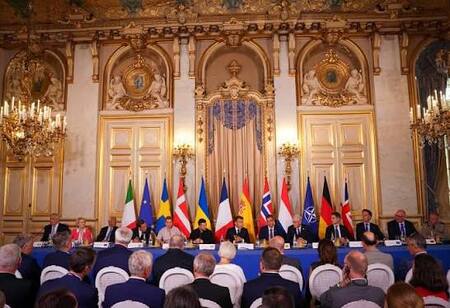
Ukraine and nine European countries have initiated the “Integrated coalition against Ballistic missiles” in a major move to enhance collective security.
On 13 July, during the Coalition of the Willing meeting in Paris, Kyiv was joined by Denmark, France, Germany, Italy, the Netherlands, Norway, Spain, Sweden, and the United Kingdom in signing a joint statement.
The initiative tackles Ukraine’s critical air defence deficiencies in light of increased Russian missile and drone assaults while setting the foundation for a wider European missile defence framework.
The summit featured leaders such as French President Emmanuel Macron, UK Prime Minister Keir Starmer, and German Chancellor Friedrich Merz, emphasizing the urgent requirement for improved interceptors and creative solutions.
Talks focused on enhancing resources for U.S.-produced Patriot systems and examining additional European options. This new coalition offers the political impetus and industrial structure required to promote these objectives, directly addressing Ukrainian President Volodymyr Zelenskyy’s continual appeals for strong missile defenses.
Central to the coalition’s initiatives is backing for FREYJA, a Ukrainian-European endeavor aimed at creating a new anti-ballistic missile system. Supported by the Ukrainian firm Fire Point, FREYJA seeks to connect with current systems like Patriot and SAMP/T while providing a more affordable solution for intercepting Russian ballistic missiles. Zelenskyy affirmed the coalition’s support for the initiative, highlighting its ability to establish a “strong barrier throughout Europe” faster and at a lower expense than depending only on existing systems.
The FP-7.X interceptor prototype, tested by Fire Point, constitutes the system's core. With a length of 7.25 meters and made from composite materials, it can achieve speeds ranging from 1,500 to 2,000 meters per second. Boasting a range of 200 kilometers and a warhead capacity of 150 kilograms, the missile employs a semi-active infrared seeker.
Also Read: Belgium to Introduce Road Tax for Local and Foreign Drivers
Fire Point intends to create this seeker in partnership with Germany's Diehl Defence, utilizing knowledge from the IRIS-T air defense system. The larger FREYJA system is intended for air and missile defense operations, primarily concentrating on addressing ballistic threats.
A significant benefit of FREYJA is its cost-effectiveness. Each interceptor is estimated to cost about $700,000, much lower than the roughly $3.8 million cost of a PAC-3 missile utilized in Patriot systems.
This cost-effectiveness may allow for increased production and greater reserves, which could be crucial during extended periods of assaults.
Also Read: Piyush Goyal to Lead Europe Delegation to Boost Trade Ties
Zelenskyy conveyed hope that the system might become functional in the upcoming twelve months, with the first coalition meeting also including delegates from prominent defense companies such as Thales, HENSOLDT, Diehl Defence, Saab, Kongsberg Defence & Aerospace, Weibel, Leonardo, MBDA, Eurosam, Safran, and Destinus.
Also Read: Von der Leyen Supports Age-Based Social Media Curbs
The collective statement highlights the coalition's objective: "Our aim is to establish a unified ballistic missile defense system for Europe." It requires a unified structure that merges current national systems with new advancements, consolidating defense industrial resources, research expertise, and operational knowledge. The signatories clearly acknowledge Ukraine's hard-earned knowledge acquired from defending against Russia’s aggression, establishing Kyiv as an essential contributor rather than just a recipient.