



France plans to enhance its nuclear capabilities and broaden its deterrence to include additional European nations, marking a significant shift in its nuclear defense strategy.
During a speech in Brittany, President Emmanuel Macron described the adjustments as a reaction to a progressively unstable strategic landscape.
"The upcoming 50 years will be a period dominated by nuclear weapons," he stated.
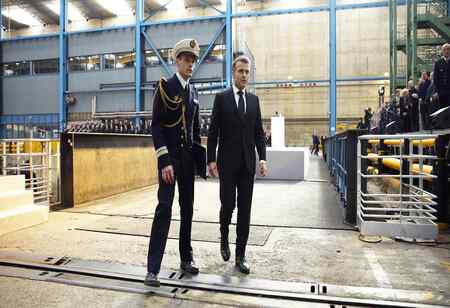
While addressing naval officers in front of a nuclear submarine at the Ile Longue facility near Brest, he announced that the count of French nuclear warheads would rise from its existing total of about 300.
He revealed the debut in 2036 of a new nuclear-capable submarine named The Invincible.
He mentioned that eight additional European nations – the UK, Germany, Poland, the Netherlands, Belgium, Greece, Sweden, and Denmark – had consented to join a new "advanced deterrence" approach.
Also Read: Five Dutch Startups Redefining Europe's Innovation Edge
In a post on X, Polish Prime Minister Donald Tusk commented on the decision, stating: "We are enhancing our defense alongside our allies so that our adversaries will never have the courage to assault us."
This would enable France's Strategic Air Forces (FAS) to "disperse throughout the European continent's depth... thereby complicating our adversaries' calculations," stated the president.
He mentioned that France's allies would also participate in creating "auxiliary" capabilities according to the new nuclear doctrine: surveillance systems in space; air defense to intercept incoming drones and missiles; and extended-range missiles.
Characterized by officials as the most important shift in French strategic thought since 1960, "advanced deterrence" still preserves a substantial portion of the original idea as articulated by President Charles de Gaulle.
Also Read: 6 Remarkable Women Entrepreneurs Stirring Up a Tech-Storm in UK
No definite "guarantee" will be provided to partner nations, and the sole authority to decide when to launch a nuclear missile will rest with the president of France.
The goal continues to persuade possible foes that "should they dare to attack France... an unbearable cost will be incurred," stated the president.
Up until now, France has intentionally remained vague regarding what it defines as its "vital interests," an assault on which would prompt a nuclear retaliation.
Also Read: Exploring Germany's AI Innovation: 5 Startups Leading the Way
In recent years, governments have suggested that "crucial interests" might also encompass interests in Europe. Macron's "advanced deterrence" has refined this idea further—although the general theory of deterrence does not provide specific details.