



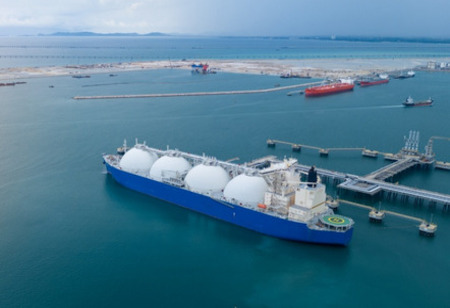
Germany has recently commenced the reception of its inaugural shipments of liquefied natural gas from Oman, despite disruptions in global supply routes due to conflicts in the Middle East.
However, a closer examination of Germany's natural gas supply chain indicates that Berlin may be more vulnerable to the crisis than official data indicates.
Also Read: Eutelsat Negotiating with ISRO to Enhance Satellite Launch Options
The announcement provides a glimmer of hope amidst the overall trend of a diminishing energy landscape. Iran's obstruction of the strait has resulted in the cessation of all LNG exports from Qatar, which is the world's second-largest exporter of LNG.
Additionally, a strike conducted by Iran on Qatar's Ras Laffan production facilities in mid-March caused the disruption of 17 percent of the Gulf state's output capacity. Saad al-Kaabi, the CEO of QatarEnergy, stated that the necessary repairs will require a timeframe of three to five years.
The company has recently declared force majeure on a number of extended contracts, impacting customers in China, South Korea, Italy, and Belgium. The Minister of Economics, Katherina Reiche, has attempted to downplay the potential risks by stating that Germany does not receive a substantial amount of LNG from the Gulf region.
Furthermore, she mentioned that 90 percent of the country's gas supply comes through pipelines from Norway, the Netherlands, and Belgium. The data is indeed precise, however, it fails to fully capture the intricate details of the situation, as stated by Capital. In the previous year, a mere 10.3 percent of Germany's gas imports were brought in through its own four liquefied natural gas (LNG) terminals, predominantly sourced from the US.
Nonetheless, the Netherlands and Belgium, whose combined gas imports made up 45 percent of Germany's total in 2025, are also prominent importers of liquefied natural gas within the European Union.
Rotterdam and Zeebrugge are significant recipients of substantial quantities of liquefied gas transported via tanker ships, which is subsequently converted back into its gaseous state and transported through pipelines into Germany. In 2025, the Zeebrugge terminal in Belgium achieved a historic milestone by processing 55.5 terawatt-hours of LNG, a figure that represents twice the amount handled in previous years.
According to a report from Capital, the Netherlands acquired 45 percent of its overall gas imports in 2024 through LNG, with shipments from the United States making up 30 percent of this amount. Due to the inability to track the source of each gas molecule traveling through the pipelines, accurately determining the extent of Germany's reliance on indirect LNG imports and its exposure to US supply remains challenging.
Also Read: France's Mistral Raises $830 Million for AI Data Centre Build-Up
However, it is evident that the general trend is apparent. Germany's storage levels are contributing to the existing pressure. According to Capital, reserves are currently at approximately 22 percent, which is unusually low for this time of year. There are limited economic motivations for stockpiling gas before the upcoming winter season due to the current alignment of short-term and future gas prices.