



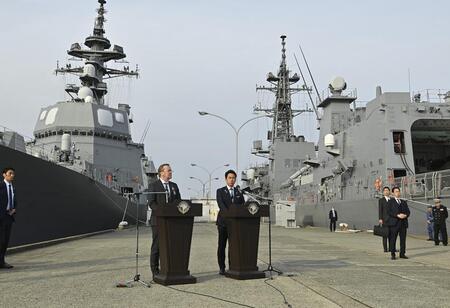
Germany aims to strengthen defense relations with Japan, as Defense Minister Boris Pistorius suggests a new pact to simplify troop operations on one another’s land.
While addressing the audience at Japan’s Yokosuka naval base following discussions with Japanese Defense Minister Shinjirō Koizumi on Sunday, Pistorius mentioned that Berlin had proposed a Reciprocal Access Agreement — a framework aimed at simplifying the exchange of personnel between the two nations and considerably lowering administrative obstacles.
These agreements facilitate the deployment of troops from partner countries on one another's territory for training, exercises, or operations by simplifying legal and administrative processes. Japan has made comparable agreements with nations such as the United Kingdom and Australia as it strengthens its security relationships in response to increasing regional tensions.
The proposal represents a progression from Germany's recent activities in the Indo-Pacific, which have primarily centered on collaborative exercises and temporary deployments. It indicates a move towards enhanced organized military collaboration with Berlin's allies in the area.
Also Read: Five Dutch Startups Redefining Europe's Innovation Edge
Pistorius presented the action as a component of a wider reaction to increasing worldwide instability. “The closeness of our partnership has been highlighted by the recent developments in Iran and the Middle East,” he stated, noting Japan’s significant dependence on energy imports via the Strait of Hormuz. "The security and assurance of maritime pathways must be upheld and safeguarded."
Also Read: 6 Remarkable Women Entrepreneurs Stirring Up a Tech-Storm in UK
Germany and Japan are interested in safeguarding global trade routes, he emphasized, noting that both nations are dedicated to the rules-based international system.
"We stand together in the belief that the power of the law must triumph," Pistorius stated.
Also Read: Exploring Germany's AI Innovation: 5 Startups Leading the Way
The effort also signifies a wider strategic transition in Berlin and Tokyo. As both nations encounter increasing pressure from authoritarian regimes — stemming from Russia's conflict in Ukraine and the situations in China and North Korea in East Asia — they are progressively viewing their security issues as linked, leading to tighter bilateral defense collaboration based on those mutual concerns.