



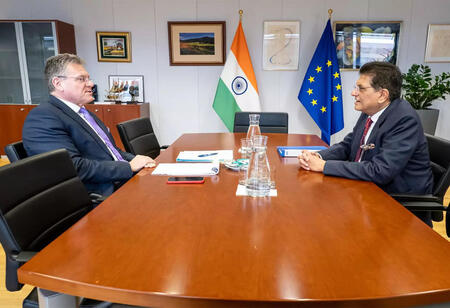
India and the European Union reiterated their dedication to the swift signing and execution of their free trade agreement during Commerce Minister Piyush Goyal's five-day trip to four European nations, with dialogues also progressing on collaboration in digital payments, technology, and investment.
Goyal's trip to Spain, Belgium, Finland, and Estonia from July 13-18 followed the conclusion of negotiations between India and the EU on their long-awaited free trade agreement earlier this month.
The minister was joined by an elite business delegation and conducted discussions with ministers, government representatives, and business executives in all four nations.
In Brussels, Goyal co-led the third India-EU Trade and Technology Council ministerial meeting, during which both parties endorsed the 2026-27 action plan and reaffirmed their commitment to promptly signing and executing the trade agreement.
The talks also addressed negotiations regarding the Investment Protection Agreement and the Geographical Indications Agreement, collaboration on the EU's Carbon Border Adjustment Mechanism (CBAM), regulatory simplification, access to agricultural markets, and India's appeal for the approval of more ship recycling facilities.
India also praised the European Union's choice to permit 21 more Indian fishery establishments, bringing the total number allowed to export to the bloc to 625.
In discussions with European Council President Antonio Costa, European Trade Commissioner Maros Sefcovic, and other high-ranking EU officials, Goyal suggested initiating a dialogue between India and the EU focused on skills, education, and talent mobility, while advocating for a more stable and business-friendly regulatory framework.
Spain and India have agreed to initiate technical talks on interoperability between India's Unified Payments Interface (UPI) and Spain's Bizum digital payments system, with the goal of enhancing cross-border digital transactions.
The two nations also talked about enhancing collaboration in automobiles, pharmaceuticals, chemicals, textiles, renewable energy, tourism, and infrastructure, while looking into joint investments in Latin America.
Goyal suggested an annual India-Spain Joint Commission meeting that includes business involvement, whereas Spain announced it would create a specific "India Team" to enhance bilateral interactions.
Also Read: EU Weighs Oil Cap, Windfall Tax to Curb Energy Costs
Speaking at the India-Spain Business Forum, Goyal encouraged firms to establish collaborations in anticipation of the India-EU trade agreement and presented a "10x10x10" strategy aimed at boosting bilateral trade, investment, and tourism ten times in the coming decade.
In Finland, discussions centered on artificial intelligence, 6G, quantum technologies, clean energy, advanced manufacturing, and innovation. Goyal urged Finnish firms, such as Nokia and elevator manufacturer KONE, to increase investments in manufacturing, research and development, and digital infrastructure in India.
The minister stated that India's extensive scale and talented workforce, along with Finland's technological know-how, presented chances for joint development and manufacturing, while talks also included university collaborations, startups, and research partnerships.
Also Read: Omio to Acquire Rail Europe in Major Rail Travel Expansion
Goyal wrapped up his trip to Estonia, marking the first ministerial visit from India since New Delhi established a resident embassy in Tallinn in 2021.
India and Estonia talked about collaboration in digital governance, fintech, UPI integration, e-residency, cybersecurity, and emerging technologies, with Estonia supporting the prompt execution of the India-EU free trade agreement and inviting India to join the Estonia Digital Summit.
Also Read: EU Plans Biggest Climate Fight by Halting Carbon Market
During the visit, Goyal encouraged European companies to adopt India as a center for manufacturing, innovation, and exports, emphasizing the nation’s digital public infrastructure, skilled labor, and expanding domestic market, as the government aims to strengthen economic relations with Europe after finishing the India-EU trade talks.