





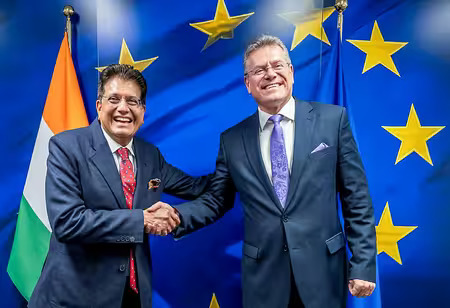
According to reports from the German environment ministry, the European Union's Carbon Border Adjustment Mechanism (CBAM) will have no exceptions, even with the finalized India-EU Free Trade Agreement (FTA), but both parties are dedicated to technical talks to determine the best path ahead.
Jochen Flasbarth, State Secretary in the German Federal Ministry for the Environment, Nature Conservation, Nuclear Safety and Consumer Protection, highlighted that the CBAM is not aimed at any particular nation but acts as an essential safeguard when carbon pricing is implemented domestically in the EU.
"CBAM does not oppose anyone. Once carbon pricing is implemented, some form of protection is necessary," Flasbarth informed during his current visit to India, where he engaged with officials from the Ministries of New and Renewable Energy, Power, and Environment, Forest and Climate Change.
Also Read: Navigating Corporate & Commercial Law: Insights from a Legal Leader
Due to carbon pricing, action is required, and this is a topic we aim to address. The free trade agreement states that there will be technical talks on the optimal method for implementation. And undoubtedly, it is evident we will not create exceptions for any other nations globally. We will not succumb to the influence of the US, for instance, or other nations, thus India can be assured there will be no exceptions," the secretary stressed.
Also Read: The Future of Corporate Learning: How Digital & Immersive Technologies Are Redefining L&D
The EU's CBAM, starting its final financial phase in January 2026, applies fees on embedded carbon emissions in imports of critical sectors like iron and steel, aluminium, and cement, among others.
This has caused worry in India, especially for carbon-heavy exports such as steel, which may incur extra expenses, possibly counteracting some tariff advantages from the FTA.
Also Read: The Future of Sustainable Maritime Operations & Biofouling Regulation
Flasbarth characterized the FTA as extremely crucial in light of increasing global trade obstacles and a challenging geopolitical context. He pointed out that although environmental and climate matters are not the focus of the agreement text, they remain essential due to the EU's dedication to climate neutrality.