



NASA has introduced a potent new telescope aimed at investigating far-off planets, supernovae, and black holes, all while mapping the universe like never before.
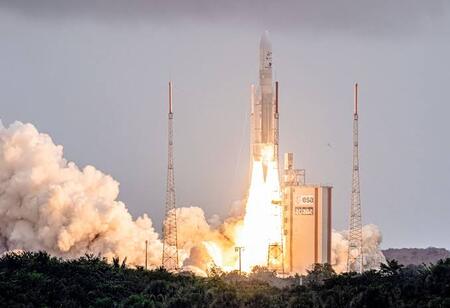
The Nancy Grace Roman Space Telescope, named for one of the earliest women in a senior leadership role at NASA, was sent into orbit on a Falcon Heavy rocket operated by Elon Musk's SpaceX from Cape Canaveral, Florida.
The telescope is anticipated to arrive at its target, around 1.6 million kilometers (nearly one million miles) away from Earth, in roughly a month's period.
The total budget for the mission exceeds $4 billion (€3.45 billion). The initial images are anticipated to return to Earth in early 2027.
Astronomers will utilize "Roman" to explore a variety of cosmic occurrences, such as black holes, exoplanets, and supernovae.
"It will discover thousands of supernovae, tens of thousands of exoplanets, billions of galaxies, and tens of billions of stars," stated NASA science mission director Nicky Fox. "It will accomplish tasks that we have never managed to achieve before due to its expansive field of vision."
Also Read: Daiichi Sankyo Appoints Markus Kosch as Europe Business Head
Roman functions similarly to the Hubble Space Telescope, which was deployed in 1990 and is currently exhibiting signs of aging while working at diminished capacity.
Also Read: Sayari, DataExpert Join Forces to Bring Sovereign AI to Europe
Nonetheless, Roman is engineered to scan the sky much faster and will finish in merely one month observations that would have required Hubble a hundred years.
Researchers anticipate that Roman will produce over 500 terabytes of data annually. In contrast, Hubble has gathered around 400 terabytes of information across more than thirty years in orbit.
Also Read: Google Changes EU Spam Policy to Address Antitrust Concerns
"Roman's extensive capability will enable us to discover the strange, the uncommon, and the extraordinary," senior project scientist Julie McEnery stated. "We'll change the concept of discovering a needle in a haystack."