



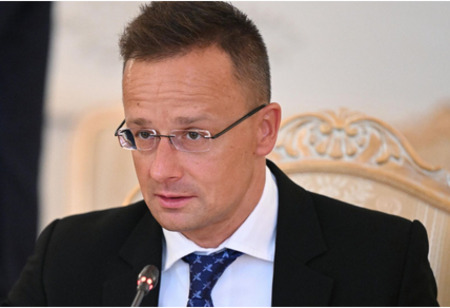
Hungarian Foreign Minister Péter Szijjártó recently traveled to Moscow to engage in discussions with Russian President Vladimir Putin and obtain assurances regarding the country's energy imports.
Hungary, along with Slovakia, remains one of the few EU countries that continue to import significant amounts of Russian oil and natural gas through pipelines.
The issue of energy prices has become a prominent point of discussion in the Hungarian electoral campaign, where the Tisza party, the opposition, currently holds a lead in opinion polls over Prime Minister Viktor Orbán's Fidesz party.
Hungary finds itself in a contentious situation with Ukraine concerning the Druzhba pipeline, which sustained damage from what is believed to be a Russian airstrike in late January.
Also Read: Jaishankar Speaks with EU VP Kaja Kallas
Budapest and Bratislava contend that the pipeline could feasibly be put into operation, while asserting that Ukraine is impeding repair efforts for political motives.
Kyiv, on the other hand, maintains that any repair work carries inherent risks and can only be carried out within the context of a ceasefire agreement with Russia. Due to the disagreement, Hungary has hindered the execution of the European Union's €90 billion loan program for Ukraine.
Upon his arrival in Moscow, Szijjártó discussed the new challenges posed by the war in Iran and the closure of the Strait of Hormuz in relation to the Druzhba situation.
He further expressed his desire for assurances from Russia regarding the provision of necessary supplies for Hungary, particularly in light of the current state of the global energy crisis.
According to Dmitry Peskov, the Kremlin spokesperson, Hungary and Slovakia are both experiencing what he described as "Ukraine's coercive tactics." Peskov also mentioned that there has been no formal request from any other European nations to resume energy supplies from Russia, despite the heightened tensions in Iran."
Szijjártó further conveyed his intention to discuss the matter of two Hungarian prisoners of war currently detained in Russia with Putin, expressing optimism that arrangements would be made for their repatriation to Hungary aboard the same flight as himself. Hungary and Slovakia previously requested Ukraine to permit their experts to evaluate the pipeline's condition. However, Kyiv did not acknowledge or respond to this specific request.
Also Read: Europe Should Focus on Industrial AI: SAP
A telephone conversation took place between European Commission President Ursula von der Leyen and Ukrainian President Volodymyr Zelenskyy, during which they discussed the pipeline matter, as reported by EU diplomats. The details of their discussion remain undisclosed. "Furthermore, Hungary made appeals to both the European Commission and Croatia for permission to receive Russian seaborne oil via the Adria pipeline.
However, Zagreb declined the request on the grounds that Russian oil is impacted by international sanctions. The Hungarian Oil Company MOL, along with Slovakia's Slovnaft, submitted an official complaint to the European Commission regarding the purported monopolistic practices of Croatian pipeline operator JANAF.