



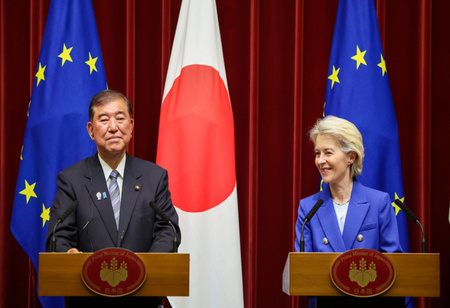
Japan has officially approved a deal that links the country to Horizon Europe, enabling Japanese researchers to participate in parts of the program on an equal footing with Europeans.
The agreement marks the most recent worldwide growth of the €93.5 billion initiative, following pacts with Canada, New Zealand, and South Korea. Japan is the most populous nation that has joined to date.
“By becoming Horizon Europe’s 23rd associated country, Japan enhances a burgeoning global network that values openness, excellence, and international collaboration as key to transforming research into innovation and innovation into prosperity,” stated research Commissioner Ekaterina Zaharieva in a statement on July 30.
The agreement allows researchers from Japan to participate in consortia seeking funding in Pillar 2 of the program, which provides grants to teams of academics and businesses to address industrial issues and confront other challenges in fields like health and climate change.
In principle, Japanese researchers had the capability to participate in such consortia. However, they had to locate their own funding source, making participation administratively complicated. They can now obtain funds directly from Brussels, facilitating collaboration with Europeans.
Also Read: Scaling Success: Europe’s Unicorn Playbook for Sustainable Growth
In exchange, Tokyo will compensate the EU with a fee for association, approximately determined by the grants its researchers obtain.
The aim is to enhance collaboration between Japanese and European researchers, similar to how Horizon Europe has reduced cooperation obstacles within EU borders.
A statement from Japan’s Ministry of Foreign Affairs indicated, “Associate participation in Horizon Europe is anticipated to enhance the engagement of Japanese companies, universities, and research institutions in international collaborative research networks focused on Europe.”
Also Read: Germany's Defense Strategy: From Military Restraint to European Leader
Currently, ambitions for this year and the next are quite constrained. According to the association agreement published by the Japanese Ministry of Foreign Affairs, Japan has committed to paying €13.7 million in 2026-27, which is approximately 0.1% of the programs budget for that timeframe.
Also Read: How EU Social Media Rules Are Influencing Global Tech Policies
That indicates the EU and Japan do not anticipate the partnership agreement will quickly lead to a spike in collaborations. However, as researchers connect and Japanese candidates become familiar with the program's administrative processes, that number might rise.