



Turkey is making significant advancements in its energy transition as it gears up to host the COP31 climate change conference this November.
The nation now hosts one of the world's largest solar installations, along with one of the largest battery storage infrastructures in Europe. Despite coal still being Türkiye’s primary source of energy, experts suggest that the country is on the path to establishing itself as a frontrunner in renewable energy within the region.
Also Read: India-UK Tech Alliance to Strengthen Global Supply Chains
A recent analysis conducted by the energy research organization Ember indicates that Türkiye has discreetly developed one of the most significant battery storage infrastructures in Europe, exceeding those of any EU member state.
Beginning in 2022, the nation implemented a requirement that all new wind and solar energy projects must be coupled with matching battery storage capabilities. This directive resulted in an unprecedented influx of applications, totaling 221 GW within a matter of months, and out of these, 33 GW have already received approval.
Although leading EU storage markets like Germany and Italy maintain capacities of 12–13 GW, Türkiye has developed a project pipeline that accounts for 83 percent of its existing wind and solar energy capacity. The report underscores that by 2025, Türkiye has established itself as a prominent paradigm within its region.
Wind and solar energy sources collectively accounted for 22 percent of electricity production, positioning Türkiye as the unequivocal frontrunner among 16 nations within the Middle East, Caucasus, and Central Asia regions.
This nation stands as the sole country within this expansive region where wind and solar energy have collectively exceeded a 20 percent contribution to electricity production.
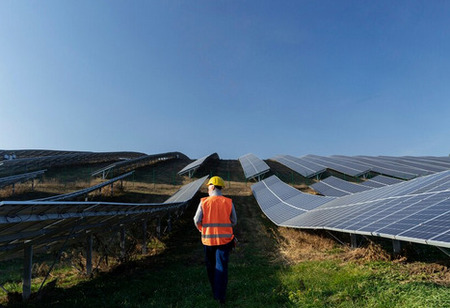
Türkiye hosts Europe's most extensive solar energy installation. The Kalyon Karapınar Solar Power Plant (SPP) features approximately 3.5 million solar panels, covering an expanse of nearly 20 million square meters, which is comparable to the collective area of 2,600 football fields.
Also Read: Belgium Signals Plan to Nationalize Nuclear Energy Sector
Photographs of the futuristic facility akin to a science fiction setting have captivated online audiences. One user on Reddit proposed that it might serve as an ideal backdrop for a new James Bond movie, while another described it as a "masterpiece."
Initiated in 2023, the project is responsible for the annual production of close to three billion kilowatt-hours of electricity. This substantial output supplies clean energy that is sufficient for the needs of a city with a population of two million.
Although Turkey has made advancements in solar energy, it continues to lag behind numerous European counterparts, placing 15th in Europe for wind power production and 16th in overall renewable energy generation. The nation must still enhance its current solar and wind capacity threefold in order to achieve its ambitious target of 120 GW by 2035, a challenging endeavor. Coal continues to serve as the principal source of energy in Türkey, accounting for 34 percent of the nation's power, with approximately two-thirds of this output dependent on imported resources.
Even though the rate of production growth has started to decelerate, it has not yet reached its zenith. Although no new coal-fired power plants have been initiated over the past three years, Ember suggests that a commitment to purchasing domestic coal until 2025 poses a threat of increased coal generation in 2026.
Also Read: India and Italy to Accelerate Defense Industrial Framework
Nonetheless, its strategic investments in renewable energy sources seem promising for the future trajectory. Alparslan states that Türkiye is presented with a remarkable opportunity to leverage its dominant position in renewable energy on a regional scale and expand this influence on a global level.
By expediting its energy storage initiatives and updating its electrical grid, Türkiye is poised to eliminate its reliance on coal. As COP31 approaches, the nation is demonstrating its capacity to transition from being an average performer in Europe to becoming a trailblazer for the entire region.