



India and the European Union (EU) reiterated their mutual dedication to advancing and safeguarding human rights during the 12th EU-India Human Rights Dialogue in the national capital, highlighting the increasing significance of democratic principles and multilateral collaboration in the face of changing global challenges.
The discussion was jointly led by Piyush Srivastava, Additional Secretary (Europe West) in the Ministry of External Affairs, and Herve Delphin, Ambassador of the European Union in India.
Both parties characterized the talks as significant, open, and candid, emphasizing the importance of sustaining regular interactions on human rights matters.
The meeting assessed progress since the last discussion in January 2025 and allowed India and the EU to share perspectives on their individual strategies, accomplishments, and difficulties in promoting human rights. Participants additionally talked about regional and global events influencing the worldwide human rights scenario.
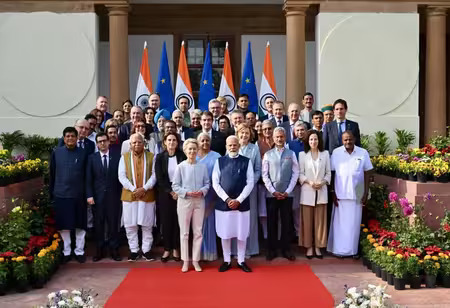
Reflecting on the significant 16th EU-India Summit that took place in New Delhi in January 2026, both parties reaffirmed their dedication to enhancing the EU-India Strategic Partnership grounded in mutual values of democracy, human rights, pluralism, the rule of law, and an international order governed by rules rooted in the United Nations.
As two of the largest democracies globally and hosts to almost a quarter of the world's population, India and the EU highlighted the universality, indivisibility, and interdependence of all human rights.
Also Read: Europe Accelerates AI Ambitions with 35 New NVIDIA Supercomputers
Conversations addressed a wide range of topics, such as civil and political freedoms, social, economic, and cultural rights, eradication of discrimination, rights of migrants, freedom of religion or belief, along with freedom of expression in both online and offline contexts.
The dialogue also focused on gender equality, LGBTQI+ rights and child rights.
Both parties reiterated their dedication to creating reliable, sustainable, and human-centered artificial intelligence, drawing from discussions conducted during the AI Impact Summit 2026, organized by India.
Humanitarian aid, collaboration on disaster relief, and the application of the UN Guiding Principles on Business and Human Rights were also significant topics in the discussions. Officials examined options for bolstering partnership in these sectors and improving coordination at multilateral platforms.
The EU and India emphasized the need to support national and international human rights bodies while protecting the autonomy and variety of civil society organizations, journalists, and other actors.
Also Read: UK Explores Forcing Social Platforms to Elevate Credible News Sources
While the EU reiterated its stance against the death penalty in any situation, India restated its enduring view that the Right to Development ought to be acknowledged as a separate, universal, and essential human right.
Both parties consented to persist in their discussions on human rights via bilateral and multilateral avenues, such as the United Nations General Assembly and the UN Human Rights Council. They additionally explored specific paths for future collaboration and discussions.
Also Read: Companies Launch InFACT for EU Packaging Recycling
The conversation ended with both parties voicing assurance in the robustness of their collaboration and anticipating the next EU-India Human Rights Dialogue set for 2027.